Bandaid Bandito Lab · Experiment Basics 001
Skincare Is Skin Science. Let’s Test It.
Introducing independent, real-world consumer skincare testing, and my first experiment
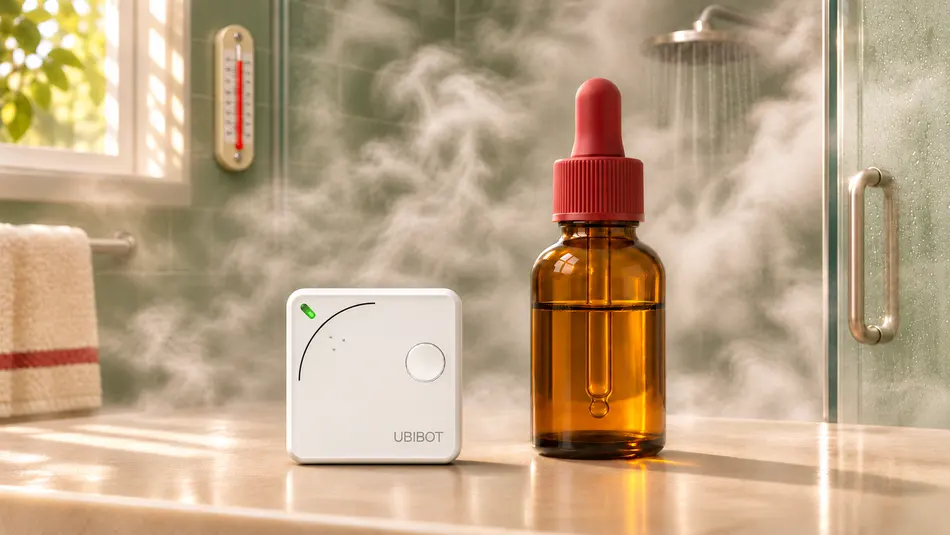
What happens to your skincare products after you bring them home?
A serum might spend months on a bathroom counter, in a cabinet under the sink, or a few feet from a hot shower. Standard cosmetic stability tests use controlled conditions. 1,2 I’ve found very little public data on the conditions skincare products actually experience once they leave the store.
That gap is where Bandaid Bandito Lab begins.
Why I started Bandaid Bandito Lab (BBL)
I'm a board-certified dermatologist and a PhD-trained cell biologist. Although I’m not in the lab anymore, my scientific training stays with me, and the fundamental operating principle that every scientist learns is: question everything. In research, nobody accepted a result just because someone reported it. Claims that “something works” were held to intense scrutiny. As one of my mentors used to say, “It’s bullshit until proven otherwise.” That wasn’t cynicism; it was a refusal to grant confidence before the evidence earned it. I learned to read the published evidence, review quality metrics, validate methods when needed, and run positive and negative controls to check whether a reagent or assay was working before trusting its results.
As a dermatologist, I hear questions about skincare products constantly. “Is this serum worth the price? Does this cream actually do anything? How should I store it?” Too often, the honest answer is that the evidence either doesn't exist or isn't public. My five to ten minutes with a patient is not enough to get into the nitty-gritty details, and my voice is often drowned out by the flood of influencer content and marketing that most consumers see every day. BBL addresses this conundrum.
I think consumers, spending their hard-earned money and wanting results, deserve a higher standard from their skincare companies: the same rigor that should apply to anything people put in or on their bodies. I started BBL to find out which products deliver on their claims and which don’t, and to say so either way.
Trust is earned through evidence
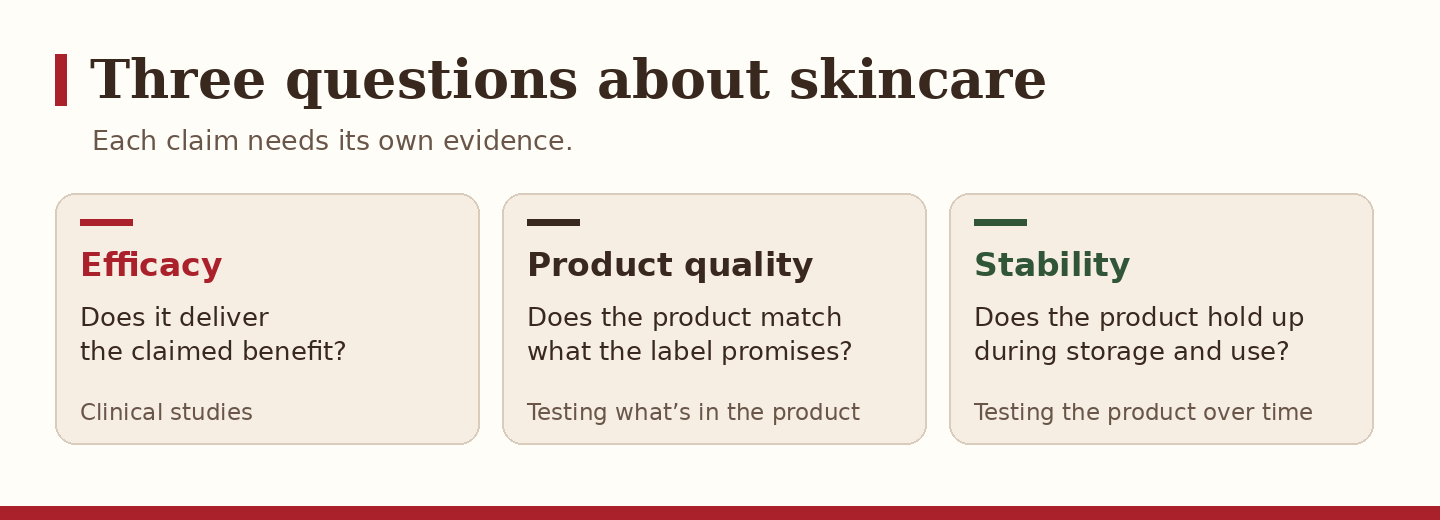
For any skincare product, three separate questions matter:
- Efficacy. Is there convincing clinical evidence that the ingredient or technology delivers the advertised benefit at this concentration or in this kind of formulation?
- Product quality. Does the product you buy contain the advertised ingredients, at the stated concentrations, in an appropriate formulation?
- Stability. Does it keep its relevant chemical and functional properties through manufacturing, shipping, warehousing, retail storage, and months of use in your home?
These questions are independent. A product can be accurately labeled and perfectly stable and still rely on an ingredient with little clinical evidence behind it. An ingredient can perform well in a clinical trial and still disappoint in a different formulation, at a lower concentration, or after a summer in a hot warehouse. And an ingredient that is chemically intact doesn't guarantee a visible result on your skin. Answering one question doesn't answer the others.
The company making a claim should show the evidence behind it. I want to see enough detail to judge whether the evidence supports the claim on the label.
My goal isn't to attack skincare companies or discourage innovation. Many products may hold up well under scrutiny, and I'll say so when they do. What I want to change is what consumers expect to see and what manufacturers feel obligated to show. I'm especially interested in the product handed to you at checkout, not just the formulation that was designed or tested. If a product falls short, I want to find out where that happened rather than assume it in advance.
Starting with my own instruments
A lab that asks manufacturers to show their evidence had better be willing to show its own. So my first experiment doesn't test a single skincare product. It tests my tools, and the environment those products live in.
Why start with the bathroom?
Heat, light, oxygen, moisture, packaging, and time can all affect the stability of some skincare ingredients; vitamin C and retinoids are well-known examples. 3,4 Before I can ask whether a product degrades in real-world use, I need to know what real-world use actually looks like.
Controlled stability tests can use elevated temperatures and humidity to accelerate changes that might take months under ordinary conditions. 1,2 A bathroom adds a different kind of exposure.
Humidity can climb during a shower and fall again afterward. How much it rises and how long it lingers are two things I want to measure.
So I'm asking simple questions first. Is a closed cabinet meaningfully different from a countertop? How much does a shower change conditions a few feet away? How quickly do they return to baseline? And how much do homes differ? Do more people, and more showers, change those conditions?
In later experiments, I’ll also look at packaging, because how a product is packaged and handled may matter nearly as much as what’s in it. A sealed bottle of a water-based serum may be fairly well protected from room humidity; an opened jar, a powder, or an anhydrous formula may not be. What happens if you leave the bottle open for too long? How long is too long?
Temperature, by contrast, is likely to matter for a wider range of products. I'm measuring both temperature and humidity because I don't yet know which conditions matter for which products: this is exactly the kind of question I'd rather answer with data than assumptions.
Five sensors, one starting point
I bought five UbiBot WS1 Wi-Fi environmental sensors to measure temperature and relative humidity with my own money. Bandaid Bandito Lab has no sponsorship or affiliate relationship with UbiBot. Each one has a permanent label, S01 through S05, so every data point can be traced to a specific device.
Before placing them around my house, I need to know whether they agree with one another. If two lines on a graph differ, is that because the conditions differ, or because the devices read the same room differently?
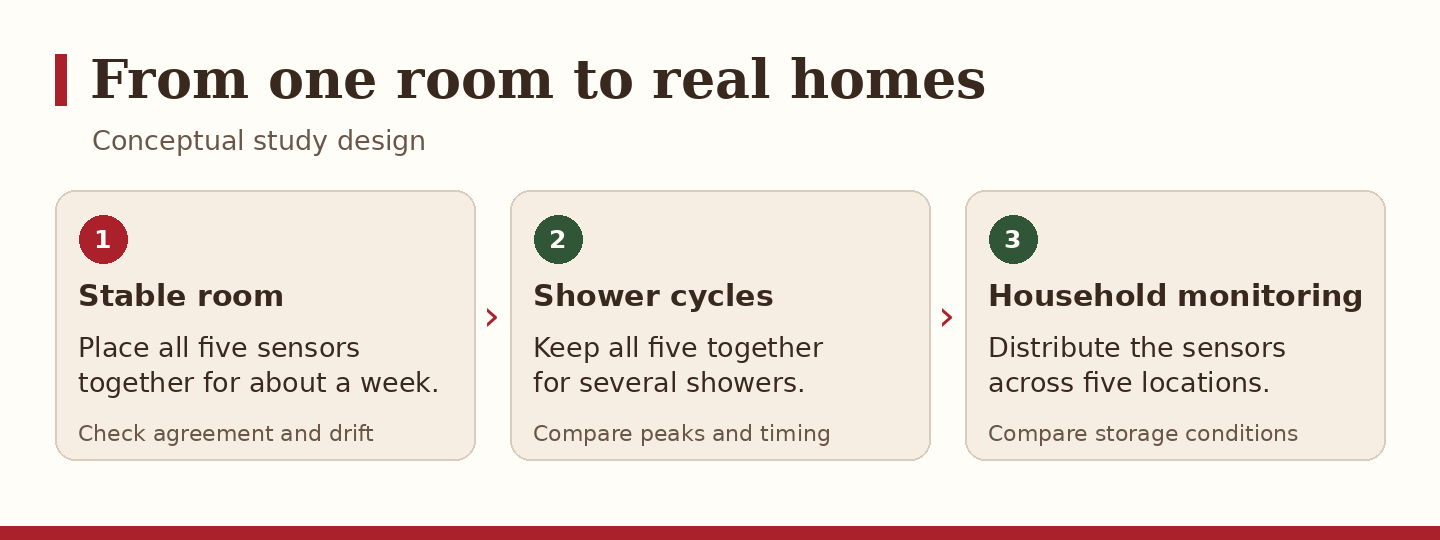
Part 1: Do they agree in a stable room?
All five sensors will sit side by side in the same dark room for about a week, away from windows, vents, drafts, and water, using the same logging interval and the same power setup. Then I'll look at four things:
- Agreement: how closely the five sensors match one another at the same moment.
- Repeatability: how consistent each sensor's readings are when conditions are stable.
- Offsets: whether any sensor reads consistently higher or lower than the rest.
- Drift: whether any sensor gradually wanders away from the group over time.
Agreeing isn't the same as being right
Before going further, I want to explain two terms that matter for everything that follows: accuracy and precision. Accuracy is how close a measurement is to the true value (the bullseye). Precision is how consistent repeated measurements are (how tightly the darts cluster).
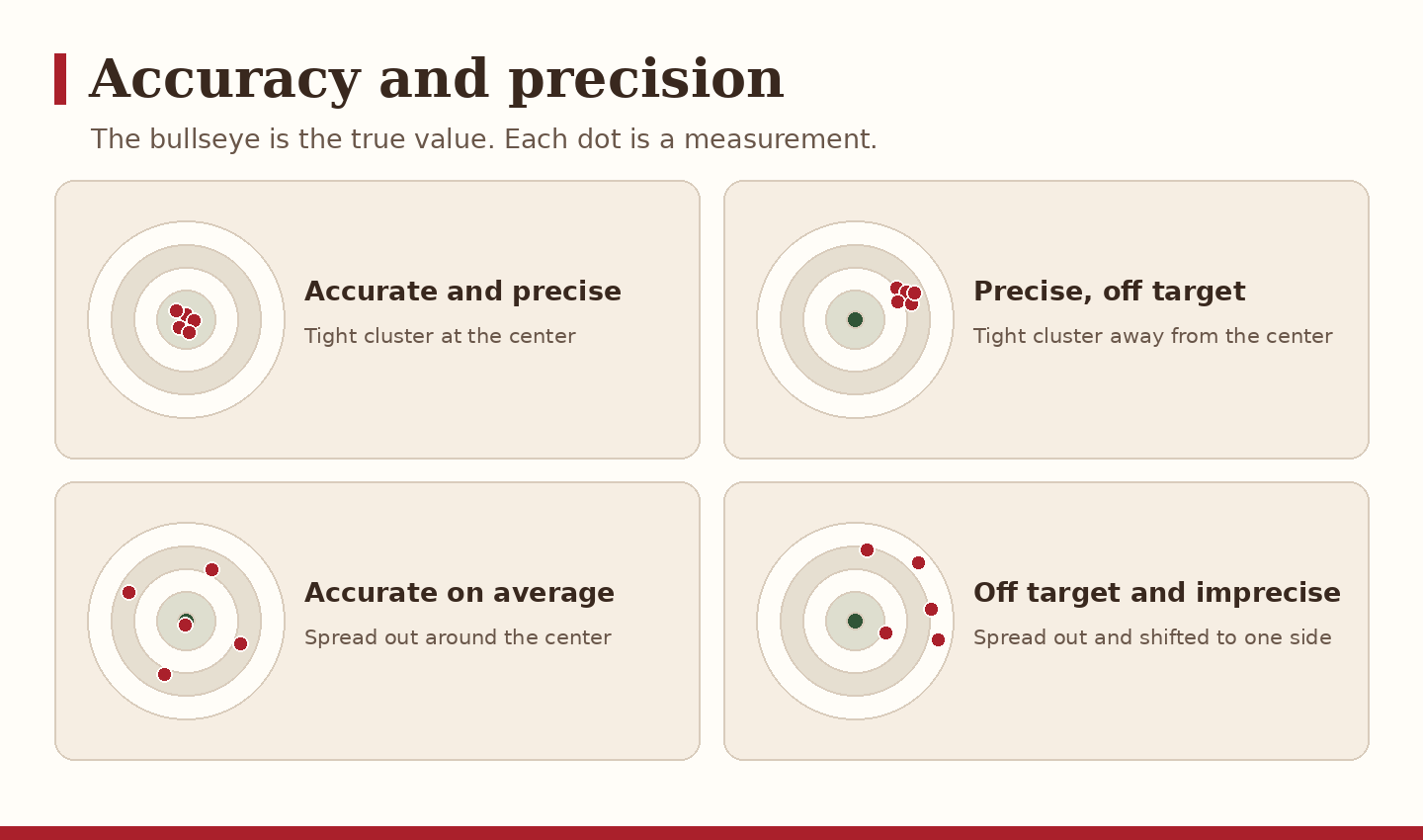
All five monitors could agree and still read a little high or low, like the upper-right dartboard. Comparing the monitors can reveal one drifting away from the group. A shared offset or drift would require an independent reference to detect.
Checking absolute accuracy requires a calibrated reference instrument, which I haven't purchased for this first experiment. Instead, I'll rely on the manufacturer's specifications (±0.2 °C from 0 to 60 °C and ±2 percentage points from 10% to 90% relative humidity) 5 and state plainly that I haven't verified them independently. For comparing locations (is the countertop more humid than the cabinet?), close agreement between sensors matters more than absolute accuracy. If later experiments need exact values, I'll add a reference.
Part 2: Do they respond the same way to showers?
Next, all five sensors will sit together in a splash-free spot in the bathroom while I record multiple ordinary showers. I'll measure how much humidity rises, how high it peaks, how temperature changes, how quickly the sensors respond, and how long conditions take to return toward baseline. I'll log shower start and stop times, fan use, door position, and anything unusual.
Two practical limits shape this phase. First, the devices I'm using are rated for 10% to 90% relative humidity without condensation, and UbiBot recommends avoiding use outside that range. 5 Air near a running shower can exceed that, so I'll report readings above 90% as at or beyond the rated range rather than as precise values, keep the sensors away from spray and condensation, and repeat a baseline sensor check afterward to make sure the shower exposure didn't change their behavior (have to make sure I didn’t steam-cook my little sensors!). Second, these monitors have plastic housings that take time to equilibrate, so "response time" partly reflects the device, not just the room. Because all five are identical, they should still let me compare locations fairly.
Part 3: What happens in real homes?
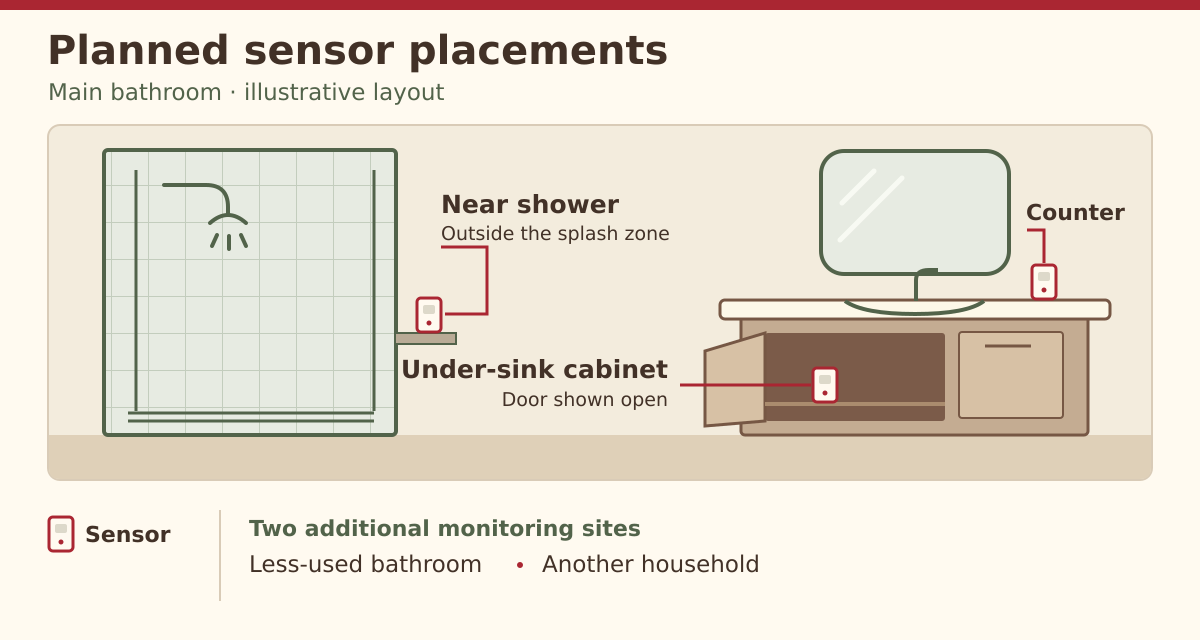
Once I've confirmed that the five devices' readings agree, the sensors will split up:
- Near the shower, within the device's safe limits
- On the bathroom countertop
- Inside the cabinet below the sink
- In a separate, less-used bathroom for comparison
- In another household
I'll compare daily patterns, shower-related spikes, and how much time each location spends at different temperature and humidity levels. With one sensor per location and two households, this is a pilot. It will show what's happening in these particular spaces, not what's typical of homes in general.
What this experiment can and cannot tell me
It can tell me:
- Whether my sensors agree with one another, and how large a difference between locations has to be before I can call it real rather than sensor-to-sensor variation.
- What temperature and humidity conditions products experience in a few real storage locations.
It cannot tell me:
- Whether the sensors are accurate in an absolute sense.
- Whether any product has degraded. Exposure to heat or humidity is not the same as demonstrated degradation; that requires measuring the product itself.
- What's typical for households in general.
What it will give me is measured, realistic conditions to use when I design controlled stability experiments on actual products.
Help shape my research
Where do you keep most of your skincare products? I’m preparing a short, anonymous survey about where readers store their products and whether the sink and shower share the same space.
Your answers will help me choose which storage conditions to test on actual products. If the bathroom countertop is the most common answer among readers who respond, I’ll prioritize it in a future stability experiment.
Survey coming soon. I’ll share the survey and its aggregate results here once they’re available. The responses will reflect the readers who choose to participate.
Science in the open
Science isn't just the finished graph. It's the decisions made before collecting data, the controls, the limitations, and a willingness to publish results that don't fit expectations. I'll share my methods, my findings, and the raw data where appropriate, including negative and inconclusive results. When I get something wrong, I'll correct it in public.
Experiment Basics 001 is deliberately modest. Later projects will look at vitamin C, retinoids, peptides, exosomes, and other heavily marketed skincare technologies, asking the same three questions: Does it work? Is it what the label says? Does it last?
Welcome to Bandaid Bandito Lab. Let’s get started.
References
- International Organization for Standardization. ISO/TR 18811:2018. Cosmetics: Guidelines on the Stability Testing of Cosmetic Products. Geneva: ISO; 2018.
- Cosmetics Europe; Cosmetic, Toiletry, and Fragrance Association (CTFA). Guidelines on Stability Testing of Cosmetic Products. March 2004.
- Stamford NPJ. Stability, transdermal penetration, and cutaneous effects of ascorbic acid and its derivatives. J Cosmet Dermatol. 2012;11(4):310-317. doi:10.1111/jocd.12006
- Temova Rakuša Ž, Škufca P, Kristl A, Roškar R. Retinoid stability and degradation kinetics in commercial cosmetic products. J Cosmet Dermatol. 2021;20(7):2350-2358. doi:10.1111/jocd.13852
- UbiBot. WS1 Wireless Smart Sensor specifications. Accessed November 2026.